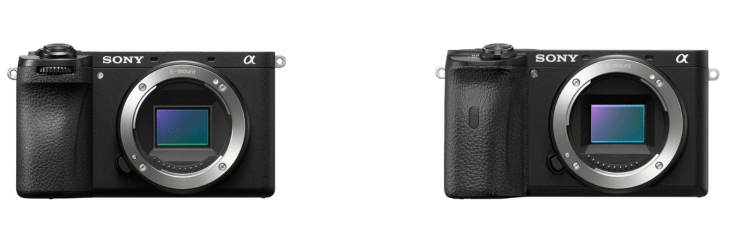
Sony A6700 & Sony A6600 share many similarities, but there are also important differences, such as quality, performance, features, design, and connectivity. If you want the best one between them, I Would recommend the Sony A6700 rather than the Sony A6600.
Why Do I Recommend The Sony A6700?
- The Sony A6700 has the BIONZ XR image processor for faster overall performance, improved autofocus calculations, and more responsive camera operation during continuous shooting and video recording, while the Sony A6600 uses the older BIONZ X processor.
- Sony A6700 features a 26-megapixel backside-illuminated APS-C sensor to deliver better light gathering efficiency, improved detail retention, and more consistent dynamic range, whereas the Sony A6600 uses a 24.2-megapixel standard APS-C sensor.
- It supports AI-based subject recognition for humans, animals, birds, insects, and vehicles to maintain more accurate focus tracking across complex scenes, while the Sony A6600 supports limited subject detection mainly for humans and animals.
- The Sony A6700 supports 4K video recording up to 120 frames per second for smooth slow-motion footage and advanced cinematic workflows, while the Sony A6600 records 4K video at up to 30 frames per second.
- Sony A6700 includes internal 10-bit 4:2:2 video recording to allow greater flexibility in color grading and reduced banding in post-production, whereas the Sony A6600 records 8-bit video internally.
- It comes with a fully articulating vari-angle touchscreen for easier self-recording, vertical video, and flexible shooting angles, while the Sony A6600 uses a tilt-only rear display.
- The Sony A6700 features UHS-II SD card support to enable faster write speeds and more reliable high-bitrate video recording, whereas the Sony A6600 uses UHS-I SD card support only.
- Sony A6700 includes a front control dial and a dedicated stills/movie/S&Q mode dial for quicker manual adjustments and improved shooting workflow, while the Sony A6600 uses a simpler control layout without these dedicated controls.
Maybe the Sony A6600 can make you comfortable because it’s a little bit cheaper than the Sony A6700. But you have to compromise all the above-mentioned features. Now the Decision is Yours. I hope it was helpful to choose the right one.
Side-by-Side Comparison
| Feature | Sony A6700 | Sony A6600 |
| Sensor Resolution | 26.0 MP | 24.2 MP |
| Sensor Type | APS-C BSI CMOS | APS-C CMOS |
| Image Processor | BIONZ XR | BIONZ X |
| Autofocus Points | 759 phase-detect | 425 phase-detect |
| AF Coverage | ~93% frame | ~84% frame |
| AI Subject Recognition | Humans, animals, birds, insects, vehicles | Humans, animals |
| Video Max Resolution | 4K 120p | 4K 30p |
| Video Oversampling | 6K to 4K | None |
| Internal Color Depth | 10-bit 4:2:2 | 8-bit 4:2:0 |
| Picture Profiles | S-Log3, S-Cinetone | S-Log2, S-Log3 |
| Active Stabilization | Active + Standard IBIS | Standard IBIS |
| LCD Articulation | Fully vari-angle | Tilting |
| LCD Resolution | 1.03M dots | 0.92M dots |
| Viewfinder Resolution | 2.36M dots | 2.36M dots |
| Front Control Dial | Yes | No |
| Mode Dial | Dedicated Stills / Movie / S&Q | Single mode dial |
| Electronic Shutter | 1/8000s | 1/4000s |
| Memory Card Support | SD UHS-II | SD UHS-I |
| Card Slot Position | Side access | Battery compartment |
| USB Port | USB-C | Micro-USB |
| USB Speed | USB 3.2 | USB 2.0 |
| Live Streaming / Webcam | Native USB streaming | Limited support |
| Body Weight (with battery) | ~493 g | ~503 g |
| Price | Check Sony A6700 Price | Check Sony A6600 Price |
What Common Both Can Do?
- Sony E-mount: Both cameras use Sony’s E-mount, allowing compatibility with a wide range of APS-C and full-frame E-mount lenses. This ensures flexibility for photographers upgrading bodies without replacing lenses.
- APS-C Sensor Format: Each model uses an APS-C sensor, balancing image quality, depth-of-field control, and portability. This sensor size is well suited for travel, wildlife, and everyday photography.
- 5-axis In-Body Image Stabilization: Both cameras include 5-axis IBIS to reduce blur from camera shake. This is especially useful for handheld shooting in low light and when using longer focal lengths.
- Maximum Mechanical Shutter Speed: The shared 1/4000s mechanical shutter allows freezing fast-moving subjects in bright conditions. This is important for sports, wildlife, and action photography.
- Continuous Shooting Speed: Both cameras shoot at up to 11 frames per second, making them capable of capturing fast action sequences. This helps photographers select the best moment from a burst of images.
- OLED Electronic Viewfinder: Each camera features an OLED EVF, providing clear, high-contrast previews. This allows accurate framing and exposure evaluation even in bright outdoor environments.
- EVF Resolution: With the same 2.36-million-dot resolution, both viewfinders deliver similar clarity and detail. Users can expect a consistent viewing experience across both models.
- Touchscreen Operation: Both models support touchscreen input for focus selection and menu interaction. This improves usability, especially for quick adjustments and video work.
- 3.0-inch LCD Display: The identical screen size ensures similar composition and playback experiences. It provides enough space for reviewing images and navigating settings comfortably.
- Wireless Connectivity: Built-in Wi-Fi allows wireless image transfer and remote camera control on both cameras. This is useful for quick sharing and mobile workflows.
- Bluetooth Connectivity: Bluetooth enables constant low-power pairing with smart devices. This supports location data transfer and seamless reconnection.
- RAW Image Capture: Both cameras support RAW files, giving photographers maximum flexibility in post-processing. This is essential for advanced color correction and exposure adjustments.
- JPEG Image Capture: JPEG support on both models allows ready-to-share images straight out of the camera. This is convenient for users who prefer minimal editing.
- Weather-Sealed Body: Each camera includes weather sealing to resist dust and moisture. This increases reliability when shooting outdoors in challenging conditions.
- NP-FZ100 Battery: Both models use the same high-capacity NP-FZ100 battery. This makes battery sharing easy for users with multiple Sony bodies.
- USB Charging: USB charging is supported on both cameras, enabling convenient power replenishment from power banks or laptops. This is especially useful for travel and long shoots.
- Microphone Input: A 3.5 mm microphone jack is present on both models for external audio recording. This improves sound quality for video creators.
- Headphone Monitoring via USB: Both cameras support audio monitoring through USB accessories. This allows users to check audio levels during video recording.
- Micro HDMI Output: Each camera uses a micro HDMI port for external monitors or recorders. This supports more advanced video setups.
- Silent Shooting Mode: Silent shooting is available on both models using the electronic shutter. This is ideal for events, wildlife, or quiet environments where discretion matters.
Common Features
| Feature | Sony A6700 | Sony A6600 |
| Lens Mount | Sony E-mount | Sony E-mount |
| Sensor Format | APS-C | APS-C |
| In-Body Stabilization | 5-axis IBIS | 5-axis IBIS |
| Max Mechanical Shutter | 1/4000s | 1/4000s |
| Continuous Shooting | 11 fps | 11 fps |
| Viewfinder Type | OLED EVF | OLED EVF |
| Viewfinder Resolution | 2.36M dots | 2.36M dots |
| Touchscreen Support | Yes | Yes |
| LCD Size | 3.0-inch | 3.0-inch |
| Wi-Fi | Yes | Yes |
| Bluetooth | Yes | Yes |
| RAW Support | Yes | Yes |
| JPEG Support | Yes | Yes |
| Weather Sealing | Yes | Yes |
| Battery Type | NP-FZ100 | NP-FZ100 |
| USB Charging | Yes | Yes |
| Microphone Input | 3.5 mm | 3.5 mm |
| Headphone Output | Via USB | Via USB |
| HDMI Output | Micro HDMI | Micro HDMI |
| Silent Shooting | Yes | Yes |
| Price | Check Sony A6700 Price | Check Sony A6600 Price |
FAQ
Is the Sony A6700 a direct replacement for the Sony A6600? Do the Sony A6700 and Sony A6600 use the same lenses? Is image quality similar between the Sony A6700 and Sony A6600 for photography? Do both cameras have in-body image stabilization? Which camera has better autofocus performance overall? Are both cameras suitable for action and wildlife photography? Can both cameras record 4K video? Do the Sony A6700 and Sony A6600 support external microphones? Is the viewfinder experience the same on both cameras? Do both models support wireless connectivity? Is battery compatibility the same between the two cameras? Which camera is better for video creators? Are the bodies weather-sealed? Is the Sony A6600 still a good choice today? Which camera is more future-proof? |