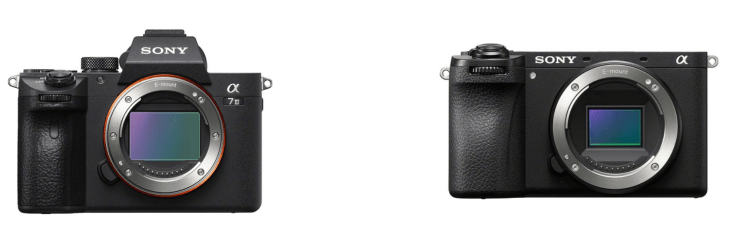
Sony A7 III & Sony A6700 share many similarities, but there are also important differences, such as quality, performance, features, design, and connectivity. If you want the best one between them, I Would recommend the Sony A7 III rather than the Sony A6700.
Why Do I Recommend The Sony A7 III?
- The Sony A7 III has a full-frame sensor for improved low-light performance, wider dynamic range, and stronger background separation in photography, while the Sony A6700 uses an APS-C sensor.
- Sony A7 III comes with larger individual pixels for cleaner high-ISO images and reduced noise in dim environments, whereas the Sony A6700 uses smaller pixels on a higher-density APS-C sensor.
- It features dual SD card slots for in-camera backup and safer professional workflow redundancy, while the Sony A6700 uses a single memory card slot.
- The Sony A7 III has longer CIPA-rated battery life for extended shooting sessions without frequent battery changes, whereas the Sony A6700 delivers shorter endurance due to higher processing demands.
- Sony A7 III includes full-frame 4K video with minimal crop for wider field-of-view consistency when using native lenses, while the Sony A6700 relies on APS-C framing for all video recording.
- It supports broader native lens performance with full-frame optics for maximum sharpness and edge-to-edge image quality, while the Sony A6700 is optimized for APS-C lenses.
- The Sony A7 III features a larger and heavier body for better balance with professional full-frame lenses during handheld shooting, while the Sony A6700 uses a smaller and lighter body.
- Sony A7 III comes with stronger native shallow depth-of-field control for portraits and subject isolation, whereas the Sony A6700 provides deeper depth-of-field at equivalent focal lengths and apertures.
Maybe the Sony A6700 can make you comfortable because it’s a little bit cheaper than the Sony A7 III. But you have to compromise all the above-mentioned features. Now the Decision is Yours. I hope it was helpful to choose the right one.
Side-by-Side Comparison
| Feature | Sony A7 III | Sony A6700 |
| Sensor Size | Full-Frame | APS-C |
| Native ISO | 100–51200 | 100–32000 |
| Expanded ISO | 50–204800 | 50–102400 |
| Log Profiles | S-Log2/3 | S-Log3, S-Cinetone |
| HDMI Port | Micro HDMI | Full-size HDMI |
| LCD Type | Tilting | Fully Articulating |
| Memory Card Slots | Dual SD | Single SD + CFexpress Type A |
| Battery Life (CIPA) | ~710 | ~570 |
| Rolling Shutter (Video) | Moderate | Reduced |
| Video Crop in 4K | Minimal | APS-C crop available |
| Price | Check Sony A7 III Price | Check Sony A6700 Price |
What Common Both Can Do?
- Lens Mount: Both cameras use Sony’s E-mount system, allowing compatibility with a wide range of native Sony lenses and third-party options. This ensures flexibility for photographers upgrading within the Sony ecosystem without replacing lenses.
- Sensor Type: Each model uses a back-illuminated CMOS sensor, which improves light-gathering efficiency and overall image quality. This design helps maintain cleaner images across various lighting conditions.
- In-Body Stabilization: Both cameras feature 5-axis in-body image stabilization to reduce camera shake during handheld shooting. This is especially useful for low-light photography and handheld video recording.
- Stabilization Rating: The shared 5.0-stop stabilization rating allows photographers to shoot at slower shutter speeds with greater confidence. This enhances sharpness when using non-stabilized lenses.
- Phase-Detect Autofocus: Each camera employs on-sensor phase-detect autofocus points for fast and accurate focusing. This benefits action photography and video autofocus reliability.
- Eye Autofocus: Both models include Eye AF to automatically detect and track human eyes. This improves portrait accuracy and reduces missed focus in shallow depth-of-field shots.
- Face Detection AF: Face detection autofocus is present on both cameras, enabling consistent focus on human subjects. This is useful for events, street photography, and casual shooting.
- Continuous Shooting: Both cameras support high-speed burst shooting suitable for sports and wildlife photography. This allows capturing fast-moving subjects with minimal missed moments.
- Electronic Shutter: Each model includes an electronic shutter option for silent shooting. This is ideal for quiet environments such as ceremonies or wildlife situations.
- Mechanical Shutter: Both cameras also retain a mechanical shutter for compatibility with flash and to reduce rolling shutter artifacts. This ensures versatility across different shooting scenarios.
- 4K Video Recording: Both cameras can record 4K video, making them capable tools for professional-quality video production. This supports high-resolution footage for modern content creation.
- S-Log Support: S-Log3 is available on both models, providing a flat gamma profile for advanced color grading. This is important for filmmakers seeking maximum dynamic range.
- Zebra Display: Zebra patterns are included on both cameras to monitor exposure highlights. This helps prevent clipped highlights during both photo and video shooting.
- Focus Peaking: Both cameras offer focus peaking to assist with manual focusing. This is particularly useful when working with manual lenses or during video focus pulls.
- OLED Electronic Viewfinder: Each camera uses a 2.36-million-dot OLED electronic viewfinder for clear composition. This allows accurate framing and exposure preview in bright conditions.
- Rear LCD Screen: Both models feature a rear LCD display for live view shooting and menu navigation. This supports flexible composition and playback review.
- Wi-Fi Connectivity: Built-in Wi-Fi allows wireless image transfer and remote control from compatible devices. This improves workflow efficiency for on-the-go sharing.
- Bluetooth Connectivity: Bluetooth is included on both cameras for persistent device pairing and location data transfer. This enhances seamless connectivity without repeated setup.
- USB Charging: Both cameras support charging via USB, enabling power from portable batteries or power banks. This is convenient for travel and extended shooting sessions.
- Weather Sealing: Each camera includes weather-resistant sealing to protect against dust and moisture. This increases reliability when shooting outdoors.
- NP-FZ100 Battery: Both models use the NP-FZ100 battery, ensuring long runtimes and cross-compatibility. This simplifies battery management for users owning multiple Sony cameras.
Common Features
| Feature | Sony A7 III | Sony A6700 |
| Lens Mount | Sony E-mount | Sony E-mount |
| Sensor Type | BSI CMOS | BSI CMOS |
| In-Body Stabilization | 5-axis IBIS | 5-axis IBIS |
| Stabilization Rating | 5.0 stops | 5.0 stops |
| Phase-Detect Autofocus | Yes | Yes |
| Eye Autofocus | Yes | Yes |
| Face Detection AF | Yes | Yes |
| Continuous Shooting | Up to 10 fps | Up to 11 fps |
| Electronic Shutter | Yes | Yes |
| Mechanical Shutter | Yes | Yes |
| 4K Video Recording | Yes | Yes |
| S-Log Support | S-Log3 | S-Log3 |
| Zebra Display | Yes | Yes |
| Focus Peaking | Yes | Yes |
| OLED Electronic Viewfinder | 2.36M-dot | 2.36M-dot |
| Rear LCD Screen | Yes | Yes |
| Wi-Fi Connectivity | Yes | Yes |
| Bluetooth Connectivity | Yes | Yes |
| USB Charging | Yes | Yes |
| Weather Sealing | Yes | Yes |
| NP-FZ100 Battery | Yes | Yes |
| Price | Check Sony A7 III Price | Check Sony A6700 Price |
FAQ
Is the Sony A7 III still a capable camera in 2026? Is the Sony A6700 suitable for professional video work? Do both cameras use the same lenses? Is image stabilization available on both cameras? Which camera performs better in low light? Can both cameras shoot 4K video? Do both cameras support S-Log profiles? Is battery life similar between the two models? Are both cameras weather sealed? Do both cameras support Eye Autofocus? Is the Sony A6700 better for action and wildlife photography? Does either camera support dual memory cards? Are both cameras suitable for travel photography? Do both cameras support USB charging? Which camera is better for long-term system investment? |