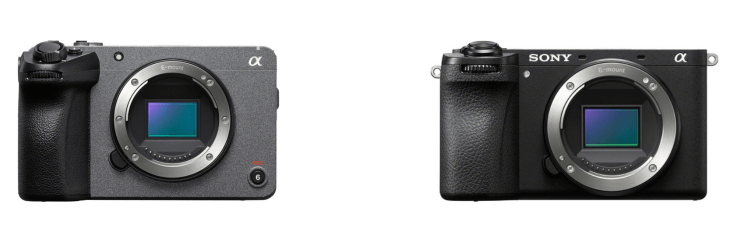
Sony FX30 & Sony A6700 share many similarities, but there are also important differences, such as quality, performance, features, design, and connectivity. If you want the best one between them, I Would recommend the Sony FX30 rather than the Sony A6700.
Why Do I Recommend The Sony FX30?
- The Sony FX30 comes with an active cooling fan for maintaining unlimited recording times during long-form video shoots and high ambient temperatures, while the Sony A6700 uses passive cooling that can impose recording limits in extended sessions.
- Sony FX30 supports a full-size HDMI Type-A port for secure, professional external monitor and recorder connections on set, whereas the Sony A6700 uses a micro HDMI port that is more fragile and less reliable for rigged workflows.
- It includes dual card slots with CFexpress Type A support for redundant recording and sustained high-bitrate video capture, while the Sony A6700 uses a single SD card slot that limits backup and data security options.
- The Sony FX30 features shutter angle control for maintaining consistent motion blur across changing frame rates in cinematic production, whereas the Sony A6700 uses shutter speed only that requires manual recalculation when adjusting frame rates.
- Sony FX30 supports 16-bit RAW video output over HDMI for maximum dynamic range and flexibility in professional color grading workflows, while the Sony A6700 does not support RAW video output.
- It comes with built-in tally lamps to clearly indicate active recording status for operators and on-camera talent, whereas the Sony A6700 has no tally lamps for visual recording confirmation.
- The Sony FX30 supports Cine EI and Flexible ISO video modes for precise exposure control in controlled lighting environments, while the Sony A6700 uses standard exposure modes designed primarily for hybrid shooting.
- Sony FX30 includes multiple 1/4-20 mounting points on the body for direct cage-free rigging of accessories and stabilization gear, while the Sony A6700 relies on a single tripod socket.
Maybe the Sony A6700 can make you comfortable because it’s a little bit cheaper than the Sony FX30. But you have to compromise all the above-mentioned features. Now the Decision is Yours. I hope it was helpful to choose the right one.
Side-by-Side Comparison
| Feature | Sony FX30 | Sony A6700 |
| Product line | Cinema Line | Alpha |
| Card slots | Dual | Single |
| Media support | CFexpress Type A / SD | SD |
| Cooling | Active fan | Passive |
| HDMI port | Full-size Type A | Micro Type D |
| Timecode | Timecode via adapter | No timecode |
| Tally lamps | Yes | No |
| Mounting points | 1/4″-20 mounting threads | None |
| Top handle support | XLR handle compatible | No XLR handle system support |
| XLR audio | Via XLR handle | No |
| Dedicated video controls | Multiple REC buttons / cine controls | Standard photo-style controls |
| Cine exposure modes | Cine EI / Flexible ISO | Standard exposure modes |
| LUT monitoring | User LUT preview | No LUT preview |
| Shutter angle | Yes | No |
| Video RAW output | 16-bit RAW over HDMI | No RAW over HDMI |
| LCD resolution | 3.0″ vari-angle, 1.44M dots | 3.0″ vari-angle, 1.04M dots |
| Body design | Box-style cine body | DSLR-style grip body |
| Price | Check Sony FX30 Price | Check Sony A6700 Price |
What Common Both Can Do?
- Sensor type: Both cameras use an APS-C Exmor R CMOS sensor, which delivers a balance of resolution, low-light performance, and manageable file sizes. This shared sensor format also allows similar depth-of-field control and lens behavior across both models.
- Sensor resolution: Each camera uses a 26.0-megapixel sensor, ensuring comparable detail for video and still frames. This matters for users who want consistent image sharpness when mixing footage from both cameras.
- Image processor: Both models rely on Sony’s BIONZ XR processor, enabling fast readout speeds and advanced image processing. This processor is critical for high-bitrate video, reliable autofocus, and responsive menus.
- Lens mount: Sony E-mount compatibility means both cameras can use the same native Sony lenses and third-party E-mount glass. This is important for system flexibility and long-term lens investment.
- Autofocus system: Each camera uses a hybrid autofocus system combining phase-detect and contrast-detect AF. This allows fast subject acquisition along with precise focus accuracy.
- AF points: With 759 phase-detect points on both models, subject coverage across the frame is nearly identical. This ensures consistent focus reliability even with off-center subjects.
- Real-time Eye AF: Both cameras support Eye AF for humans and animals, maintaining sharp focus on eyes during movement. This is especially valuable for interviews, portraits, and documentary shooting.
- Real-time Tracking: Sony’s Real-time Tracking works on both models to follow moving subjects automatically. This reduces missed shots and minimizes the need for manual focus adjustments.
- ISO range: The shared ISO range of 100–32,000 allows both cameras to perform similarly in low-light conditions. This consistency is helpful when matching footage shot in varying lighting environments.
- In-body stabilization: Both include 5-axis in-body image stabilization, reducing camera shake for handheld shooting. This improves usability for run-and-gun video and handheld stills.
- Max video resolution: Each camera records up to 4K UHD, ensuring modern high-resolution output. This makes both suitable for professional delivery standards and future-proof workflows.
- Max video frame rate: Support for up to 4K 120p on both models enables smooth slow-motion footage. This is important for cinematic effects and action capture.
- Log profiles: S-Log3 and S-Gamut3 are available on both, providing wide dynamic range for color grading. This allows footage from either camera to integrate seamlessly into professional post-production pipelines.
- Picture profiles: Both cameras include customizable picture profiles, letting users fine-tune color and contrast. This helps maintain consistent looks across different shooting setups.
- LCD type: The 3.0-inch vari-angle touchscreen on both models supports flexible framing. This is useful for vlogging, low-angle shots, and self-recording.
- Touch control: Touch AF and menu navigation are supported on both cameras, improving usability. This speeds up operation during fast-paced shoots.
- Battery type: Both use the NP-FZ100 battery, offering strong endurance and cross-compatibility. Sharing batteries simplifies power management for multi-camera users.
- USB charging / power: USB-C Power Delivery support allows continuous power and charging during use. This is important for long recording sessions and studio setups.
- Wireless connectivity: Wi-Fi and Bluetooth are built into both cameras for remote control and file transfer. This enhances workflow efficiency, especially for solo creators.
- Body material: Magnesium alloy construction on both models improves durability and heat management. This ensures reliability during extended shooting sessions.
Common Features
| Feature | Sony FX30 | Sony A6700 |
| Sensor type | APS-C Exmor R CMOS | APS-C Exmor R CMOS |
| Sensor resolution | 26.0 MP | 26.0 MP |
| Image processor | BIONZ XR | BIONZ XR |
| Lens mount | Sony E-mount | Sony E-mount |
| Autofocus system | Hybrid phase/contrast AF | Hybrid phase/contrast AF |
| AF points | 759 phase-detect | 759 phase-detect |
| Real-time Eye AF | Yes | Yes |
| Real-time Tracking | Yes | Yes |
| ISO range (base) | 100–32,000 | 100–32,000 |
| In-body stabilization | 5-axis IBIS | 5-axis IBIS |
| Max video resolution | 4K | 4K |
| Max video frame rate | 4K up to 120p | 4K up to 120p |
| Log profiles | S-Log3 / S-Gamut3 | S-Log3 / S-Gamut3 |
| Picture profiles | Yes | Yes |
| LCD type | 3.0″ vari-angle touchscreen | 3.0″ vari-angle touchscreen |
| Touch control | Yes | Yes |
| Battery type | NP-FZ100 | NP-FZ100 |
| USB charging / power | USB-C Power Delivery | USB-C Power Delivery |
| Wireless connectivity | Wi-Fi / Bluetooth | Wi-Fi / Bluetooth |
| Body material | Magnesium alloy chassis | Magnesium alloy chassis |
| Price | Check Sony FX30 Price | Check Sony A6700 Price |