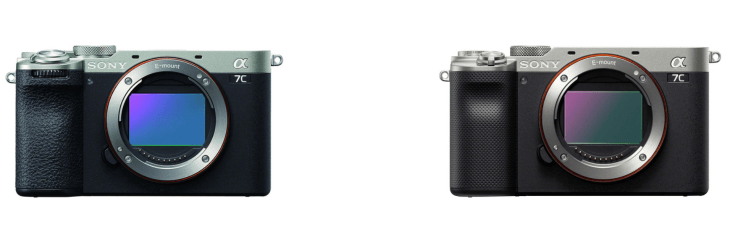
Sony A7C II & Sony A7C share many similarities, but there are also important differences, such as quality, performance, features, design, and connectivity. If you want the best one between them, I Would recommend the Sony A7C II rather than the Sony A7C.
Why Do I Recommend The Sony A7C II?
- The Sony A7C II has the BIONZ XR image processor for significantly faster overall performance, deeper buffer handling, and improved system responsiveness, while the Sony A7C uses the older BIONZ X processor.
- Sony A7C II features AI-based subject recognition autofocus to maintain accurate tracking of humans, animals, birds, insects, vehicles, and aircraft in complex scenes, whereas the Sony A7C supports limited subject recognition focused mainly on humans and animals.
- It includes 759 phase-detection autofocus points for wider frame coverage and more precise focus placement, while the Sony A7C has 693 phase-detection autofocus points.
- The Sony A7C II supports real-time recognition AF to keep moving subjects locked in focus during unpredictable motion, whereas the Sony A7C relies on standard real-time tracking without advanced AI recognition.
- Sony A7C II supports 4K video recording at up to 60p for smoother motion capture and better slow-motion flexibility, while the Sony A7C is limited to 4K video at 30p.
- It supports 10-bit 4:2:2 internal video recording for greater color depth and significantly improved color grading flexibility, whereas the Sony A7C records 8-bit 4:2:0 video.
- The Sony A7C II comes with Cine EI video workflow support to provide consistent exposure management and professional post-production control, while the Sony A7C lacks Cine EI support.
- Sony A7C II includes enhanced Active Mode image stabilization to deliver smoother handheld video with reduced micro-jitters, while the Sony A7C uses a less advanced Active Mode stabilization system.
Maybe the Sony A7C can make you comfortable because it’s a little bit cheaper than the Sony A7C II. But you have to compromise all the above-mentioned features. Now the Decision is Yours. I hope it was helpful to choose the right one.
Side-by-Side Comparison
| Feature | Sony A7C II | Sony A7C |
| Image Processor | BIONZ XR | BIONZ X |
| Sensor Processing Generation | New | Older |
| Autofocus System | AI-based hybrid AF | Hybrid AF |
| Phase-Detect AF Points | 759 | 693 |
| AI Subject Recognition | Human, Animal, Bird, Insect, Vehicle, Aircraft | Human, Animal |
| Real-Time Recognition AF | Yes | No |
| Bird Eye AF | Yes | No |
| Eye AF in Video | Full support | Limited |
| Maximum Video Resolution | 4K 60p | 4K 30p |
| 4K Oversampling Method | 7K oversampled | 6K oversampled |
| Internal Video Bit Depth | 10-bit | 8-bit |
| Chroma Subsampling | 4:2:2 | 4:2:0 |
| Cine EI Support | Yes | No |
| Picture Profile System | S-Log2, S-Log3, Cine EI | S-Log2, S-Log3 |
| Creative Color System | Creative Look | Creative Style |
| Custom LUT Import | Yes | No |
| Active Stabilization | Enhanced Active Mode | Active Mode |
| Continuous Shooting Buffer | Larger | Smaller |
| LCD Resolution | Higher | Lower |
| Menu Interface | New touch UI | Older UI |
| USB Standard | USB-C 3.2 | USB-C 2.0 |
| USB Streaming | UVC/UAC | Limited |
| Power Management | Improved efficiency | Standard |
| AI Framing Assist | Yes | No |
| Price | Check Sony A7C II Price | Check Sony A7C Price |
What Common Both Can Do?
- Sensor Type: Both cameras use a full-frame Exmor R CMOS sensor, allowing them to capture high-detail images with strong dynamic range. This shared sensor format is important for achieving professional-level image quality and shallow depth of field.
- Sensor Resolution: Each model features a 33-megapixel sensor, enabling high-resolution still photography suitable for large prints and detailed cropping. This resolution also balances file size with image clarity.
- Lens Mount: Both cameras use the Sony E-mount, providing access to Sony’s extensive lineup of native lenses and third-party options. This ensures system compatibility and long-term expandability.
- In-Body Stabilization: Both models include 5-axis in-body image stabilization, helping reduce camera shake during handheld shooting. This is especially useful for low-light photography and video recording.
- Mechanical Shutter: Each camera includes a mechanical shutter, allowing reliable performance under artificial lighting and minimizing rolling shutter effects. This is important for flash photography and action shooting.
- Electronic Shutter: Both cameras support an electronic shutter, enabling silent shooting in environments where noise is undesirable. This is useful for events, wildlife, and street photography.
- Maximum Continuous Shooting: Both models support up to 10 frames per second burst shooting, allowing users to capture fast-moving subjects effectively. This shared capability suits sports and action photography.
- Autofocus Type: Both cameras use a hybrid autofocus system combining phase-detect and contrast-detect AF. This provides a balance of speed, accuracy, and reliability across different shooting scenarios.
- Face Detection AF: Each camera includes face detection autofocus, allowing consistent focus on human subjects. This is particularly valuable for portrait and event photography.
- Eye AF (Human & Animal): Both cameras support eye autofocus for humans and animals, ensuring sharp focus on eyes during still photography. This improves hit rates for portraits and pet photography.
- ISO Sensitivity Range: Both models share a native ISO range of 100–51,200, allowing flexibility in various lighting conditions. This ensures usable performance from bright daylight to low-light scenes.
- Expanded ISO: Each camera supports expanded ISO values down to 50 and up to 204,800, giving photographers additional exposure flexibility. This can be helpful in controlled lighting or extreme low-light situations.
- Video Recording Format: Both cameras record video using the XAVC S codec, ensuring consistent file compatibility and efficient compression. This makes editing workflows straightforward across both models.
- Picture Profiles: Both cameras include S-Log2 and S-Log3 picture profiles, enabling greater dynamic range for video color grading. This is important for users who want cinematic post-production flexibility.
- Viewfinder Type: Each model uses an OLED electronic viewfinder, providing clear, high-contrast previews. This helps with accurate composition and exposure assessment.
- EVF Resolution: Both cameras share a 2.36-million-dot EVF resolution, offering detailed and responsive viewing. This consistency ensures a familiar shooting experience between models.
- LCD Type: Both feature a vari-angle touchscreen LCD, supporting flexible shooting angles and intuitive menu navigation. This is beneficial for vlogging, selfies, and creative compositions.
- Battery Model: Each camera uses the NP-FZ100 battery, delivering long battery life and easy battery sharing between bodies. This is important for travel and extended shoots.
- Memory Card Slot: Both models include a single UHS-II SD card slot, supporting fast write speeds and reliable storage. This ensures smooth handling of high-resolution photos and video.
- Wireless Connectivity: Both cameras support Wi-Fi and Bluetooth, enabling wireless image transfer and remote control. This simplifies sharing and remote shooting workflows.
- Body Form Factor: Both cameras share a compact, rangefinder-style body design, making them portable while maintaining full-frame capability. This form factor is ideal for travel and everyday photography.
Common Features
| Feature | Sony A7C II | Sony A7C |
| Sensor Type | Full-frame Exmor R CMOS | Full-frame Exmor R CMOS |
| Sensor Resolution | 33 MP | 33 MP |
| Lens Mount | Sony E-mount | Sony E-mount |
| In-Body Stabilization | 5-axis IBIS | 5-axis IBIS |
| Mechanical Shutter | Yes | Yes |
| Electronic Shutter | Yes | Yes |
| Maximum Continuous Shooting | 10 fps | 10 fps |
| Autofocus Type | Hybrid AF | Hybrid AF |
| Face Detection AF | Yes | Yes |
| Eye AF (Human & Animal) | Yes | Yes |
| ISO Sensitivity Range | 100–51,200 | 100–51,200 |
| Expanded ISO | 50–204,800 | 50–204,800 |
| Video Recording Format | XAVC S | XAVC S |
| Picture Profiles | S-Log2, S-Log3 | S-Log2, S-Log3 |
| Viewfinder Type | OLED EVF | OLED EVF |
| EVF Resolution | 2.36M-dot | 2.36M-dot |
| LCD Type | Vari-angle touchscreen | Vari-angle touchscreen |
| Battery Model | NP-FZ100 | NP-FZ100 |
| Memory Card Slot | Single SD | Single SD |
| Wireless Connectivity | Wi-Fi, Bluetooth | Wi-Fi, Bluetooth |
| Body Form Factor | Compact rangefinder-style | Compact rangefinder-style |
| Price | Check Sony A7C II Price | Check Sony A7C Price |