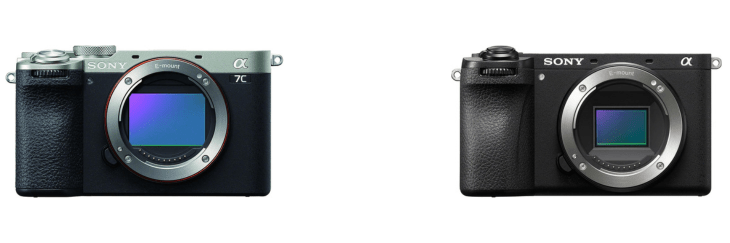
Sony A7C II & Sony A6700 share many similarities, but there are also important differences, such as quality, performance, features, design, and connectivity. If you want the best one between them, I Would recommend the Sony A7C II rather than the Sony A6700.
Why Do I Recommend The Sony A7C II?
- The Sony A7C II features a full-frame 33MP sensor for higher resolution images with greater detail and improved dynamic range, while the Sony A6700 uses an APS-C 26MP sensor.
- Sony A7C II has a full-frame sensor for cleaner high-ISO performance and better low-light noise control, whereas the Sony A6700 relies on a smaller APS-C sensor with more visible noise at equivalent ISO levels.
- It includes up to 7.0-stop in-body image stabilization for more stable handheld shooting in low light and telephoto scenarios, while the Sony A6700 supports up to 5.0-stop stabilization.
- The Sony A7C II supports full-frame 7K oversampled 4K video for higher detail and reduced aliasing in standard video recording, whereas the Sony A6700 uses a smaller APS-C oversampled readout.
- Sony A7C II comes with greater background separation for portraits and cinematic shots due to its full-frame sensor size, while the Sony A6700 produces deeper depth of field at the same framing and aperture.
- It has wider native field of view with full-frame lenses for landscape and architectural photography, whereas the Sony A6700 applies a 1.5× crop factor that narrows the field of view.
- The Sony A7C II features higher dynamic range headroom for better highlight retention and shadow recovery in RAW files, while the Sony A6700 provides comparatively less post-processing latitude.
- Sony A7C II supports stronger pixel-level light gathering for smoother tonal transitions and more natural color gradation, while the Sony A6700 uses smaller pixels with reduced light capture per pixel.
Maybe the Sony A6700 can make you comfortable because it’s a little bit cheaper than the Sony A7C II. But you have to compromise all the above-mentioned features. Now the Decision is Yours. I hope it was helpful to choose the right one.
Side-by-Side Comparison
| Feature | Sony A7C II | Sony A6700 |
| Sensor format | Full-frame | APS-C |
| Sensor size | 35.9 × 23.9 mm | 23.5 × 15.6 mm |
| Crop factor | 1.0× | 1.5× |
| Effective resolution | 33 MP | 26 MP |
| ISO (standard stills) | 100–51200 | 100–32000 |
| ISO (expanded stills) | 50–204800 | 50–102400 |
| IBIS rating | Up to 7.0 stops | Up to 5.0 stops |
| 4K 60p sensor area | Super 35 / crop | APS-C / crop modes vary |
| 4K 30p sampling | 7K oversample | 6K oversample |
| Full-frame video readout | Yes | No |
| EVF magnification | 0.70× | 1.07× |
| Body size class | Compact full-frame | Compact APS-C |
| Weight (with battery/card) | Heavier | Lighter |
| Typical lens class | FE | E |
| Equivalent field of view (same focal length) | Wider | Narrower |
| Depth of field (same framing/aperture) | Shallower | Deeper |
| Pixel-level low-light noise | Lower | Higher |
| Dynamic range headroom | Higher | Lower |
| Subject separation | Stronger | Weaker |
| Price | Check Sony A7C II Price | Check Sony A6700 Price |
What Common Both Can Do?
- Mirrorless camera type: Both models use a mirrorless design, allowing for smaller bodies and faster live-view autofocus performance. This design also enables real-time exposure preview through the electronic viewfinder and LCD.
- Interchangeable lens mount: Both cameras use the Sony E-mount, providing access to a wide range of native Sony lenses and third-party options. This ensures long-term system flexibility for different shooting styles.
- Back-illuminated CMOS sensor: Each camera employs a BSI CMOS sensor, which improves light-gathering efficiency. This helps maintain image quality, especially in challenging lighting conditions.
- BIONZ XR image processor: Both share Sony’s BIONZ XR processor, enabling fast data processing and responsive camera operation. This processor supports advanced autofocus, high-speed shooting, and modern video features.
- AI-based subject recognition AF: Each camera integrates AI-driven subject recognition for humans, animals, and birds. This allows more reliable tracking of moving subjects in both photo and video shooting.
- Phase-detection autofocus: Both models use on-sensor phase-detection autofocus points. This results in fast focus acquisition and improved subject tracking accuracy.
- Real-time Eye AF (Human/Animal/Bird): Eye autofocus is available for multiple subject types on both cameras. This feature helps maintain critical focus on eyes during portraits, wildlife, and action shooting.
- In-body image stabilization: Both cameras include 5-axis in-body stabilization to reduce camera shake. This improves handheld shooting stability for stills and video, especially in low light.
- Mechanical + electronic shutter: Each camera supports both shutter types, giving flexibility between silent shooting and traditional mechanical operation. This is useful across different shooting environments.
- Continuous shooting support: Both models are capable of high-speed continuous shooting. This makes them suitable for capturing action, sports, and fast-moving subjects.
- 4K video recording: Both cameras can record 4K video internally. This ensures high-resolution footage suitable for modern content creation and professional workflows.
- S-Log3 / S-Gamut3: Log profiles are available on both models for advanced color grading. This allows greater dynamic range and flexibility in post-production.
- HLG video profile: Each camera supports HLG for HDR video output. This enables HDR-ready footage with minimal post-processing.
- Fully articulating touchscreen LCD: Both cameras feature a vari-angle touchscreen that flips and rotates. This is particularly useful for vlogging, low-angle shots, and self-recording.
- Electronic viewfinder: An OLED electronic viewfinder is present on both models. This provides a clear, detailed preview of exposure, color, and focus.
- Touch AF / Touch tracking: Touch-based autofocus control is supported on both cameras. This allows quick subject selection and intuitive focus control.
- Wi-Fi connectivity: Wireless connectivity is built into both models for image transfer and remote control. This simplifies sharing and mobile workflow integration.
- Bluetooth connectivity: Bluetooth support enables constant low-energy connections with smart devices. This improves pairing stability and background location data transfer.
- USB-C interface: Both cameras use USB-C for charging and data transfer. This supports faster connections and modern accessory compatibility.
- HDMI output: Each camera includes a Micro HDMI port for external monitoring or recording. This is important for video-centric setups.
- External microphone support: A 3.5 mm microphone input is available on both models. This allows improved audio quality with external microphones.
- NP-FZ100 battery series: Both cameras use Sony’s NP-FZ100 battery type. This ensures good battery life and compatibility across Sony bodies.
- Dust & moisture resistance: Both models feature basic weather sealing. This improves reliability when shooting outdoors or in less controlled environments.
Common Features
| Feature | Sony A7C II | Sony A6700 |
| Mirrorless camera type | Yes | Yes |
| Interchangeable lens mount | Sony E-mount | Sony E-mount |
| Back-illuminated CMOS sensor | Yes | Yes |
| BIONZ XR image processor | Yes | Yes |
| AI-based subject recognition AF | Yes | Yes |
| Phase-detection autofocus | Yes | Yes |
| Real-time Eye AF (Human/Animal/Bird) | Yes | Yes |
| In-body image stabilization | 5-axis | 5-axis |
| Mechanical + electronic shutter | Yes | Yes |
| Continuous shooting support | Yes | Yes |
| 4K video recording | Yes | Yes |
| S-Log3 / S-Gamut3 | Yes | Yes |
| HLG video profile | Yes | Yes |
| Fully articulating touchscreen LCD | Yes | Yes |
| Electronic viewfinder | OLED | OLED |
| Touch AF / Touch tracking | Yes | Yes |
| Wi-Fi connectivity | Yes | Yes |
| Bluetooth connectivity | Yes | Yes |
| USB-C interface | Yes | Yes |
| HDMI output | Micro HDMI | Micro HDMI |
| External microphone support | 3.5 mm jack | 3.5 mm jack |
| NP-FZ100 battery series | Yes | Yes |
| Price | Check Sony A7C II Price | Check Sony A6700 Price |
FAQ
Which camera is better for photography overall, Sony A7C II or Sony A6700? Which camera performs better in low light? Is the Sony A6700 better for video than the Sony A7C II? Do both cameras use the same lenses? Which camera is better for wildlife and sports photography? Is there a difference in autofocus performance between the two? Which camera is better for portraits? Are both cameras suitable for professional work? Do both cameras have in-body image stabilization? Which camera is better for travel and portability? Is battery life similar between the two models? Do both cameras support professional video profiles? Which camera is better for beginners moving to advanced shooting? Is there a difference in image sharpness between the two? Which camera offers better long-term system value? |